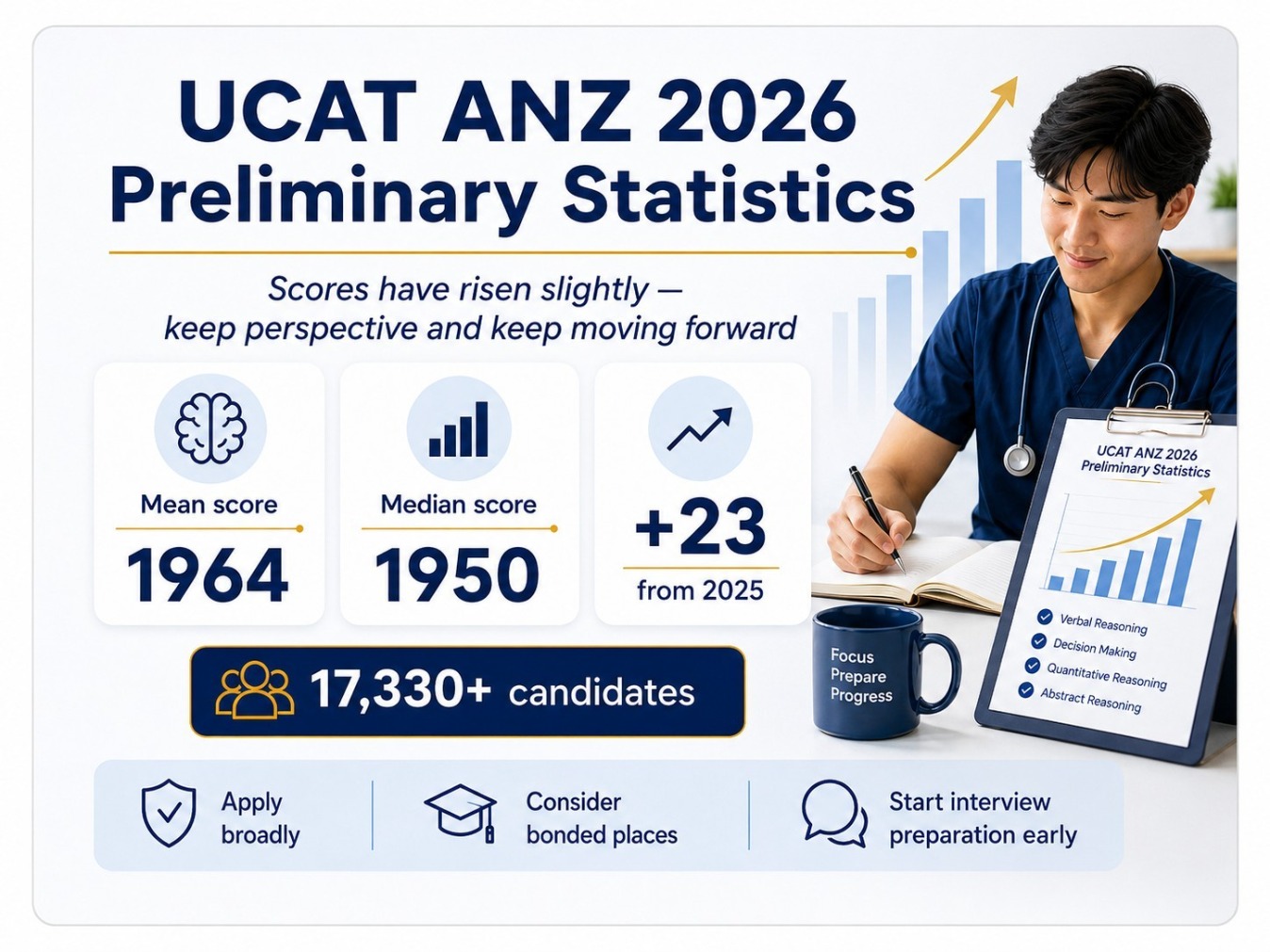
UCAT ANZ 2026 Preliminary Statistics
UCAT ANZ 2026 preliminary statistics show a modest increase in average scores, with the mean cognitive score rising to 1964. Find out what the latest results mean for medical and dental applicants, why students should keep perspective, apply broadly and begin interview preparation early.
Post-UCAT Advice & Medical Interviews Introductory Session
FREE Live Webinar
Spots are limited. If you can't attend, register to receive a recording of the webinar after the session.
REGISTER FOR THE FREE WEBINARKey message: The 2026 mean Total Cognitive Scaled Score increased from 1941 in 2025 to 1964 in 2026 – a rise of only 23 points, or approximately 1.2%. The median increased from 1930 to 1950. This is a modest upward movement rather than a dramatic change in the UCAT landscape.
|
1964
2026 preliminary mean cognitive score
|
1950
2026 preliminary median cognitive score
|
+23
Increase in mean total score from 2025
|
17,330+
UCAT ANZ 2026 candidates
|
UCAT ANZ 2026 Preliminary Results at a Glance
The 2026 preliminary statistics show that the average total score has increased slightly compared with 2025. The rise is most noticeable in Decision Making and Quantitative Reasoning, while Verbal Reasoning is essentially unchanged.
| UCAT Section | 2025 Mean | 2026 Mean | Change |
|---|---|---|---|
| Verbal Reasoning | 620 | 619 | -1 |
| Decision Making | 642 | 655 | +13 |
| Quantitative Reasoning | 679 | 691 | +12 |
| Total Cognitive Score | 1941 | 1964 | +23 |
| Situational Judgement | 586 | 580 | -6 |
The preliminary 2026 median scores are 610 for Verbal Reasoning, 650 for Decision Making, 680 for Quantitative Reasoning, 1950 for the Total Cognitive Score and 589 for Situational Judgement.
The Increase Is Real – But It Is Relatively Small
When students hear that UCAT scores have increased, the immediate reaction can be to assume that this year's admissions process will suddenly be much harder.
The numbers do not support that level of concern.
The mean increased by 23 points, while the median increased by 20 points. On a cognitive scale extending to 2700, this represents a relatively modest movement.
Keep this in perspective: the 2026 figures represent a continuation of the gradual upward movement seen in recent years, rather than an abrupt change in the UCAT landscape.
Students today have access to a wide range of preparation resources, mock examinations, analytics and structured training. While we cannot know exactly what has contributed to the gradual change in national scores, the 2026 increase remains relatively modest.
We Still Do Not Know the Final 2026 Percentiles
These figures are preliminary statistics. More detailed information, including the total-score percentile distribution, will become available later in the testing cycle.
Do not make final conclusions about your UCAT result yet. A score that feels disappointing today may look different once the full percentile distribution becomes available.
For historical results and an explanation of how percentiles are interpreted, see NIE's UCAT ANZ Scores & Percentiles guide.
Students who want to estimate how a practice-test result compares with previous UCAT cohorts can also use the NIE UCAT Practice Score & Percentile Calculator.
Even after national percentiles are released, that still will not tell us exactly what score will be required for every university interview.
Nobody Yet Knows the Final UCAT or ATAR Interview Cut-Offs
A national UCAT percentile is not the same thing as a medical school interview cut-off.
Universities use UCAT ANZ in different ways. Some combine UCAT and academic performance, while others rank applicants within particular applicant groups or quotas.
Effective thresholds can change depending on the strength of the applicant pool, ATAR results, available interview places and each university's selection method.
Apply Broadly – Give Yourself Every Reasonable Opportunity
One of the biggest mistakes students can make after receiving a UCAT result is deciding for themselves that they are no longer competitive.
If you are eligible to apply, consider applying to all appropriate medical or dental programs for which you meet the requirements.
- Admission processes can change from year to year.
- Applicant pools change.
- ATAR distributions change.
- UCAT distributions change.
- Different applicant categories may be ranked differently.
- Interview performance can significantly affect the final outcome.
Your job is to put forward the strongest application you can. Let the universities decide whether you receive an interview.
Consider Bonded Medical Places If the Commitment Suits You
Students applying for medicine should also consider bonded medical places if they genuinely understand and are comfortable with the associated rural or regional return-of-service requirements.
Bonded places should never be selected casually. However, for students who are genuinely open to working in regional, rural or remote Australia, choosing a bonded place can broaden the number of medical places for which they may potentially be considered.
In some university selection structures, unbonded places are offered to the highest-ranked applicants first and bonded places are offered after those places have been allocated.
Important: This does not mean every university always applies a lower UCAT or ATAR cut-off to bonded places. Selection rules differ by university and should always be checked carefully.
If Your UCAT Score Looks Competitive, Start Interview Preparation Now
Students who feel reasonably confident about their UCAT performance should strongly consider beginning medical interview preparation before receiving an interview invitation.
Interview invitations can be followed by a relatively short preparation period. Students who wait until the offer arrives may then be trying to develop communication skills, ethical reasoning, motivation responses and MMI techniques while also managing school, examinations and university applications.
Medical and dental interviews can assess areas such as:
- communication and empathy;
- ethical reasoning and judgement;
- motivation for medicine or dentistry;
- teamwork and leadership;
- conflict management;
- critical thinking;
- resilience and self-awareness;
- public and rural health;
- Indigenous health; and
- the ability to think clearly under pressure.
Think of an interview invitation as the signal to intensify your preparation – not the signal to begin it.
A Lower UCAT Score Does Not Mean You Failed UCAT
There is no traditional pass or fail mark in UCAT ANZ. UCAT is a ranking test.
You simply score higher or lower relative to other candidates.
A lower score does not mean that you are not intelligent enough for medicine, that you cannot become a doctor or dentist, or that you should give up on your career goal.
It means that on one particular test, on one particular day, your performance placed you at a particular point within that year's cohort.
A disappointing result can still become a valuable part of your progress if you choose to learn from it.
Learn From the Experience and Keep Improving
If your result was lower than you hoped, ask yourself what the experience taught you.
- Did you begin preparation too late?
- Was one UCAT section consistently weaker?
- Did you complete enough timed practice?
- Did anxiety or pacing affect your performance?
- Did you review your mistakes properly?
- Did your preparation method suit the way you learn?
Those observations are valuable. If you learn from the experience, you are already better positioned than you were before you sat the test.
That process is how difficult goals are ultimately achieved.
There Is More Than One Pathway Into Medicine or Dentistry
Medicine and dentistry are highly competitive courses, and excellent candidates sometimes miss an interview.
One UCAT result should not be allowed to define your future.
Depending on your circumstances, consider:
- All universities for which you are eligible for
- Other eligible admission pathways
- Bonded medical places if the commitment suits you
- Medical or dental programs that do not require UCAT
- Graduate-entry pathways (GAMSAT pathway)
- Alternative undergraduate degrees that preserve future options
- Preparing now for interviews where you may still be competitive
The 2026 Statistics Should Encourage Perspective, Not Panic
The preliminary results tell us that UCAT ANZ performance has moved slightly upward again.
The mean increased by 23 points. The median increased by 20 points.
That is worth recognising, but it is not an enormous structural shift.
The complete percentile data are not yet final. University interview thresholds are not yet known. ATAR results are not yet known. Applicant pools have not yet been fully ranked. Interviews have not yet taken place.
If medicine or dentistry is genuinely the career you want, continue building the strongest pathway available to you.
Sometimes the route is direct. Sometimes it takes another year. Sometimes it takes a different degree.
The important thing is to keep learning, keep improving and keep giving yourself opportunities.
Keep Moving Forward With Your Preparation
Explore NIE's structured medical interview and UCAT preparation options to strengthen your skills, confidence and readiness for the next stage of medical or dental entry.
Explore Interview Preparation Explore UCAT PreparationFrequently Asked Questions
Have UCAT ANZ scores increased significantly in 2026?
No. The preliminary mean total increased by 23 points compared with 2025, which is approximately a 1.2% increase. It is better described as a modest continuation of the recent upward trend.
Do we know the final UCAT ANZ 2026 percentiles yet?
No. The current figures are preliminary. More detailed percentile information is released later in the testing cycle.
Does a lower UCAT score mean I failed?
No. UCAT ANZ is a ranking test and does not have a traditional pass or fail mark. A lower score means you ranked lower relative to other candidates in that testing cohort.
Should I begin medical interview preparation before receiving an interview offer?
If you believe you may be competitive, beginning gradually can be beneficial. Early preparation gives you more time to develop communication, ethical reasoning, response structure and confidence.
Disclaimer: This article is provided for general educational guidance only. UCAT scores, percentiles, university selection criteria and interview thresholds can change. Students should always check current university and UCAT ANZ information before making application decisions.