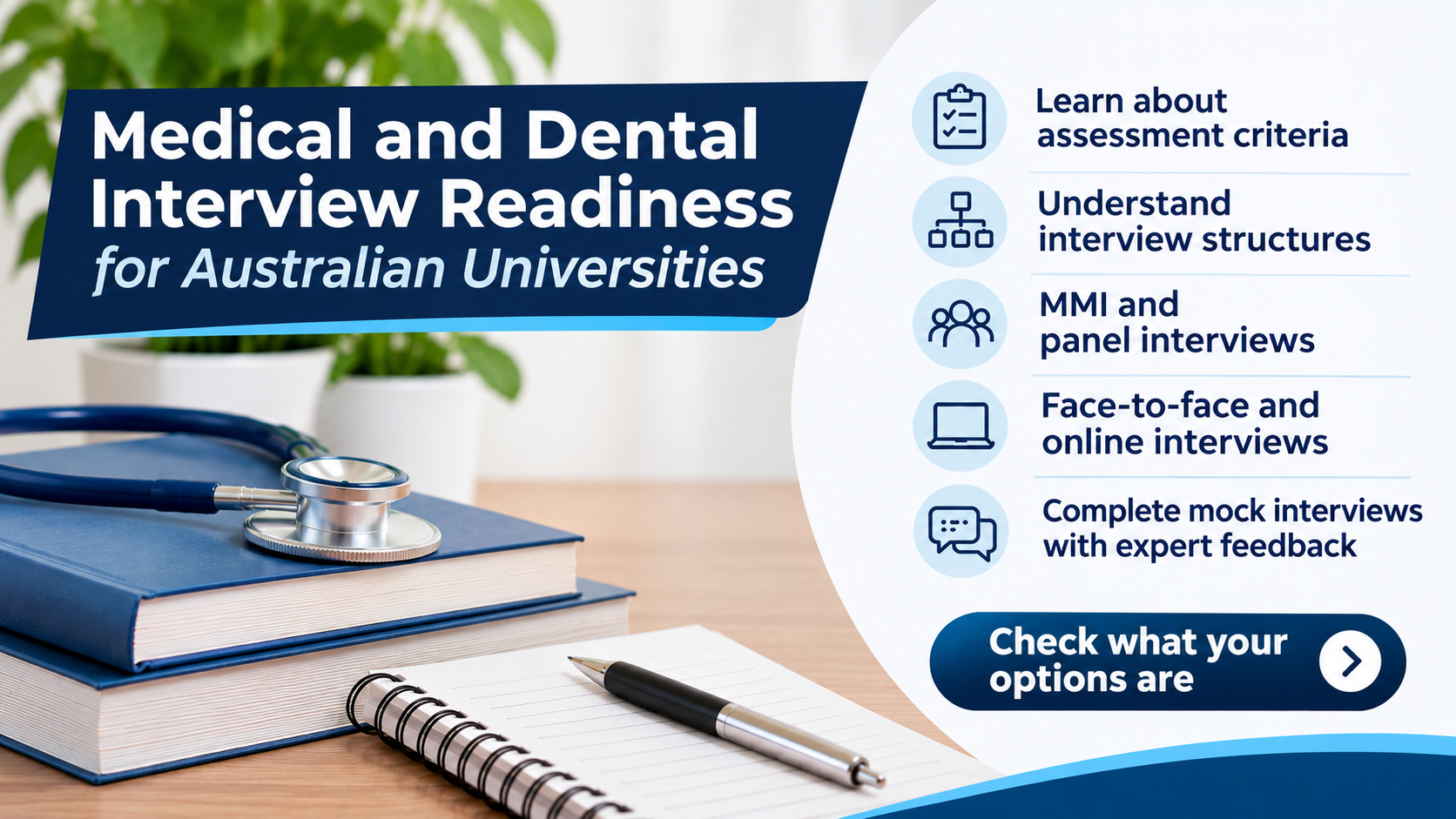
With medical and dental interviews approaching, now is an important time to focus on your interview preparation. We understand that many students have not yet received their interview offers. However, we strongly encourage you not to overlook this crucial stage of the university admissions process.
Some universities provide very little notice between releasing interview invitations and conducting interviews. Waiting until you receive an offer may therefore leave you with limited time to prepare effectively and approach your interview with confidence.
Medical and dental interviews assess much more than academic achievement. Universities want to understand how you communicate, think through unfamiliar situations, respond to ethical questions and reflect on your experiences.
The National Institute of Education (NIE) offers free introductory webinars, comprehensive medical interview workshops, individual interview coaching and specialised preparation programs for students applying to medicine and dentistry.
Upcoming Medical Interview Webinars and Training
Whether you are preparing for your first interview or looking to improve your performance through additional practice, the following options can help you choose the level of support that suits your needs.
FREE LIVE ONLINE WEBINAR
Introduction to Medical Interviews
Thursday, 5 November 2026
6.00 pm - 7.30 pm (AEDT / Sydney time)
Live online | Free registration
If you are unsure what to expect from a medical school interview, this free webinar is a useful place to start.
The session will be presented by Zobair Bary, Director of NIE and founder of Future Doctors Australia. Zobair has spent more than 20 years assisting students with medical entry in Australia and New Zealand.
The webinar will cover:
- What universities assess during medical interviews
- MMI, panel, online and recorded interview formats
- Common interview mistakes and how to avoid them
- How to draw on your personal experiences when answering questions
- When students should begin preparing
- Independent preparation, workshops and one-on-one coaching
- Questions and answers with the presenter
Suitable for students, parents and teachers. Registration is required.
COMPREHENSIVE INTERVIEW TRAINING
Medical and Dental Interview Training Workshop
NIE's live, interactive two-day workshop provides structured preparation for medical and dental school interviews, including Multiple Mini Interviews (MMIs) and panel interviews.
Students explore different interview formats, learn how to approach common question types and participate in practical exercises designed to develop their communication and reasoning skills.
The workshop covers interview structures, assessment criteria, ethical and situational questions, personal reflection and techniques for responding to unfamiliar scenarios.
Students also have opportunities to practise their responses and receive constructive feedback.
This workshop is a recommended starting point for students who have not yet completed comprehensive interview training.
VIEW UPCOMING INTERVIEW WORKSHOP DATESView the workshop page for current dates, delivery options and availability.
PERSONALISED INTERVIEW COACHING
One-on-One Medical Interview Training
Individual coaching is suitable for students who would like more personalised support, additional mock interview practice or detailed feedback on their interview performance.
These sessions can be particularly beneficial for students who have already attended an interview workshop and would like to build on what they have learned.
2-Hour Medical Interview Tune-Up
A focused coaching session for students who already have some interview preparation experience and want to refine their responses, practise challenging questions and identify areas for improvement.
VIEW 2-HOUR INTERVIEW TUNE-UP3-Hour One-on-One Interview Training
A more extensive individual session providing additional opportunities for interview practice, response development and personalised feedback.
This option may be suitable for students seeking more intensive preparation, particularly when an interview date is approaching.
VIEW 3-HOUR ONE-ON-ONE TRAININGCOMBINED PREPARATION OPTION
Medical Interview Training Package
If you would like to combine the comprehensive interview workshop with individual coaching, NIE also offers a medical interview training package.
This option is worth considering if you want to begin with structured group training and then continue developing your skills through personalised practice and feedback.
The workshop provides a foundation in interview formats, question types and response techniques, while individual coaching allows you to focus more closely on your own interview performance.
VIEW MEDICAL INTERVIEW TRAINING PACKAGEPlease refer to the product page for the package inclusions and current booking information.
SPECIALISED MEDICAL INTERVIEW WEBINAR
Public, Rural and Indigenous Health: Medical Interview Readiness
Saturday, 21 November 2026
Live online training
Final scheduled webinar of this kind for 2026.
Understanding healthcare challenges in Australia is an important part of medical interview preparation, particularly for universities that assess applicants' awareness of public health, rural and remote healthcare, health inequities and Aboriginal and Torres Strait Islander health.
This specialised training helps students develop their understanding of these topics and practise discussing them in a thoughtful, informed and respectful manner.
The session is particularly relevant to applicants preparing for interviews where rural, regional, community and Indigenous health issues may be explored.
VIEW AND BOOK - 21 NOVEMBER WEBINARPlease check the booking page for session details and availability.
Why Start Medical Interview Preparation Before Receiving an Offer?
Receiving an invitation to interview is an important milestone in the medical or dental school application process. However, the amount of preparation time available after an invitation arrives varies between universities.
Starting early allows you to develop your ideas, practise communicating under pressure and become more comfortable responding to unfamiliar questions.
It also gives you time to reflect on personal experiences that may be relevant to interview questions, including teamwork, volunteering, employment, leadership, setbacks and situations in which you learned something important.
Students completing Year 12 may find that short, regular practice sessions are easier to manage than trying to prepare intensively immediately before an interview.
Our advice is to begin learning about interview formats and assessment criteria before receiving an invitation. You can start developing useful skills even before you know which universities will invite you to interview.
Understanding MMI and Panel Medical Interviews
Australian and New Zealand medical and dental schools use different interview formats. The format, timing, assessment criteria and delivery method depend on the university.
Multiple Mini Interviews (MMIs)
Multiple Mini Interviews usually involve a series of shorter interview stations. Each station may focus on a particular skill, quality or scenario.
Depending on the university, applicants may be asked to discuss an ethical dilemma, respond to a healthcare-related scenario, reflect on a personal experience or participate in a communication exercise.
Effective MMI preparation involves learning how to interpret questions, organise your thoughts, explain your reasoning and communicate clearly within a limited period.
Panel Interviews
Panel interviews typically involve a longer conversation with one or more interviewers.
Questions may explore your motivation for studying medicine or dentistry, personal experiences, understanding of healthcare, ethical reasoning and communication skills.
Although panel interviews may feel more conversational than MMIs, they still require thoughtful preparation and clear responses.
Face-to-Face, Online and Recorded Interviews
Some universities conduct interviews face-to-face, while others use online or recorded response formats.
Students should become familiar with the relevant technology, instructions and response timing before their assessment.
Always consult official university information, as interview arrangements can change.
What Do Medical and Dental Schools Assess in Interviews?
Medical and dental interviews are designed to explore qualities that academic results and admissions tests cannot fully assess.
Although universities use different assessment criteria, commonly evaluated areas include:
- Communication and interpersonal skills
- Empathy, respect and emotional awareness
- Ethical reasoning and judgement
- Critical thinking and problem-solving
- Teamwork, collaboration and leadership
- Motivation for studying medicine or dentistry
- Self-awareness and personal reflection
- Professionalism and responsibility
- Understanding of healthcare challenges
- Ability to respond constructively to feedback
Some universities also explore applicants' awareness of rural and remote healthcare, Aboriginal and Torres Strait Islander health, health equity, cultural safety and the responsibilities of healthcare professionals.
Strong interview preparation involves more than learning facts. Students should be able to explain their reasoning, consider different perspectives and reflect thoughtfully on their experiences.
How to Prepare Effectively for a Medical School Interview
There is no single preparation method that suits every applicant. However, the following steps provide a practical foundation.
1. Research Your University Interview Formats
Check whether your universities use MMIs, panel interviews, recorded responses or other assessment methods.
Read the official information carefully and pay attention to any published assessment criteria, instructions and preparation guidance.
2. Reflect on Your Personal Experiences
Consider experiences from school, employment, volunteering, extracurricular activities, sport, family responsibilities and community involvement.
Think about what happened, how you responded, what you learned and how the experience may influence your future behaviour.
3. Practise Speaking Your Answers Aloud
Thinking about an answer is different from communicating it clearly under time pressure.
Practise explaining your ideas aloud without relying on memorised scripts. Focus on answering the question directly and supporting your reasoning with relevant examples.
4. Develop Your Awareness of Healthcare Issues
Build a general understanding of patient-centred care, medical ethics, access to healthcare, professional responsibilities and challenges affecting health services.
You are not expected to have the knowledge of a qualified doctor, but you should demonstrate curiosity, sound reasoning and a willingness to consider different perspectives.
5. Participate in Mock Interviews
Mock interviews provide an opportunity to practise responding to unfamiliar questions in a more realistic setting.
Constructive feedback can help you identify communication habits, improve your response structure and become more comfortable with challenging scenarios.
6. Review Your Performance and Practise Again
Interview preparation is a process of gradual improvement. After each practice session, consider what worked, what was unclear and what you would approach differently.
Repeated practice with meaningful feedback is generally more useful than simply memorising a large collection of sample answers.
Common Medical Interview Mistakes to Avoid
Students often focus on finding the perfect answer. However, interviewers are usually interested in how applicants think, communicate and reflect.
Common preparation mistakes include:
- Waiting until an interview offer arrives: This can leave insufficient time for practice.
- Memorising complete responses: Rehearsed answers may sound unnatural or fail to address the actual question.
- Not answering the question directly: A lengthy response is not necessarily an effective response.
- Making unsupported assumptions: Ethical and situational questions often require consideration of missing information.
- Overlooking personal reflection: Describing an experience without explaining what you learned can weaken your answer.
- Practising without feedback: Students may repeat the same communication habits without recognising them.
- Using the same approach for every university: Interview formats and assessment criteria can differ significantly.
The aim of interview preparation is not to create scripted answers. It is to help you communicate naturally, reason clearly and demonstrate genuine reflection.
Additional Medical Interview Preparation Options
Students who have completed introductory preparation may benefit from further practice or training focused on particular interview requirements.
Advanced MMI and Panel Interview Training
Students seeking additional interview practice can explore the Advanced Medical Interview Entry Training (AMIET) program.
Public, Rural and Indigenous Health Preparation
Healthcare access, rural and remote health, public health and Indigenous health may be relevant to interview discussions at certain universities.
NIE offers specialised public, rural and Indigenous health interview preparation for students wishing to develop their understanding of these topics.
Bond University Preparation
Applicants to Bond University should familiarise themselves with its particular medical selection process.
NIE offers Bond University psychometric preparation and advanced Bond University interview training.
You can also explore NIE's interview tutors and coaching team to learn more about the support available.
Frequently Asked Questions About Medical Interviews
Select a question below to view the answer. These are some of the most common questions students ask when preparing for medicine and dentistry interviews in Australia and New Zealand.
When should I start preparing for medical interviews?
Ideally, begin before receiving an interview invitation. This gives you more time to understand interview formats, reflect on your experiences and practise communicating your answers. You can begin with short, regular practice sessions.
Should I prepare if I have not received an interview offer?
Yes. Some universities provide limited notice between issuing invitations and conducting interviews. Preparing early can reduce the amount of work required once an offer arrives.
What is an MMI medical interview?
A Multiple Mini Interview, or MMI, usually consists of several short stations. Each station may assess different skills through scenarios, questions or practical communication exercises. The number of stations and their format depend on the university.
What is the difference between MMI and panel interviews?
MMIs typically involve a series of shorter stations, while panel interviews involve a longer discussion with one or more interviewers. Both may assess communication, ethical reasoning, motivation, reflection and interpersonal skills.
What questions are asked in medical school interviews?
Questions vary between universities. Common topics include motivation for medicine, teamwork, ethical dilemmas, communication, personal experiences, problem-solving and awareness of healthcare issues.
Can I prepare for medical interviews on my own?
Yes. Independent preparation can include researching university requirements, reflecting on experiences, practising questions aloud and learning about healthcare issues. Workshops and mock interviews can provide additional structure and feedback.
Are medical interview workshops worth attending?
A structured workshop can help students understand interview formats, practise different question types and receive feedback. Its value depends on the student's preparation needs, the workshop content and the opportunities for active practice.
Is one-on-one interview coaching useful?
Individual coaching can be particularly helpful for students who want personalised feedback, more realistic mock interview practice or assistance with specific communication and response skills.
Do medical and dental interviews assess the same skills?
There is considerable overlap, including communication, ethical reasoning, empathy and professionalism. However, dental interviews may also explore motivation for dentistry and understanding of dental practice. Assessment requirements vary between universities.
Should I memorise answers to medical interview questions?
Memorising complete answers is generally less useful than developing a clear approach to unfamiliar questions. Interviewers may ask follow-up questions or present scenarios you have not seen before. Genuine reflection and adaptable communication are important.
How can I prepare for rural and Indigenous health interview questions?
Begin by developing an understanding of healthcare access in rural and remote communities, health inequities, cultural safety and the health priorities of Aboriginal and Torres Strait Islander peoples. Use reliable sources, avoid stereotypes and practise discussing these issues respectfully.
NIE also offers specialised public, rural and Indigenous health interview training.
Ready to Begin Your Medical Interview Preparation?
Whether you are waiting for an interview invitation or already have an interview scheduled, there are practical steps you can take now.
Start by understanding what universities assess, then choose a preparation option that matches your experience and the time available.
VIEW UPCOMING INTERVIEW WORKSHOPS VIEW ALL INTERVIEW TRAINING OPTIONS